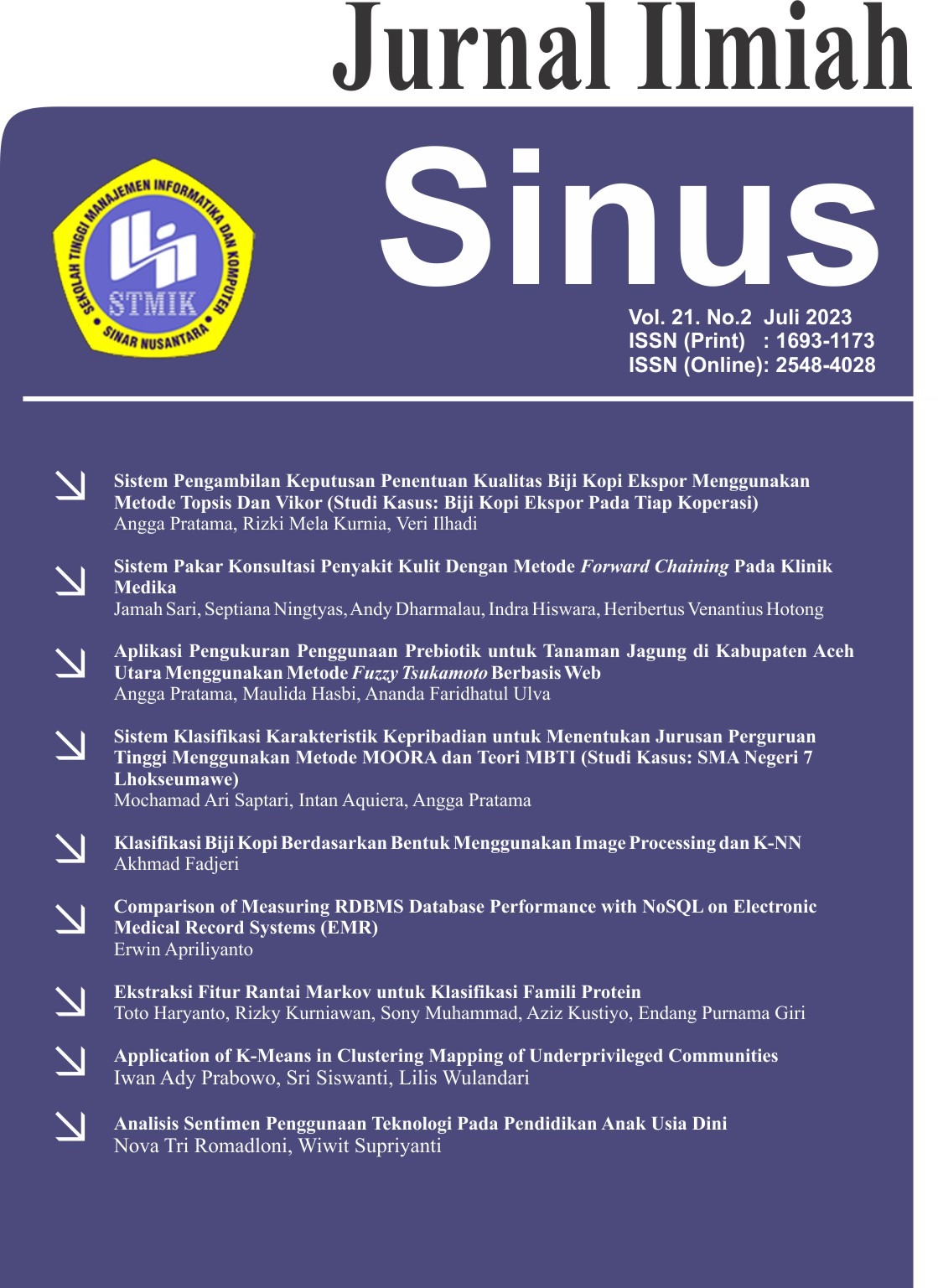
Application of K-Mean in Clustering Mapping of Underprivileged Communities
DOI:
https://doi.org/10.30646/sinus.v21i2.734Keywords:
K-Means, Geographic Informations Systems, Mapping, Poor PeopleAbstract
Jatiyoso is one of 17 sub-districts in Karanganyar Regency, Central Java Province. Through this sub-district office, residents can take care of various forms of permits. There are many other functions and duties of the subdistrict office. The distance from the county seat is 30.0 km to the south. Jatiyoso is divided into 9 village areas, namely, Jatisawit, Jatiyoso, Karangsari, Petung, Tlobo, Wonokeling, Wonorejo, and Wukirsawit. With the total population of Jatiyoso District is 40,709 people. With a large population, and also a large amount of poverty. To help reduce poverty in Jatiyoso District, Jatiyoso District, an information system is needed that can explain the mapping of poverty areas in Jatiyoso Village. This information system is expected to assist the government in distributing aid to the poor. K-Means method was applied in this study to overcome the problem of grouping poor families by category. According to the findings of study, there were 23 groups of persons with low assets (C1) and four groups of people with substantial assets (C2). The findings of the feasibility testing process with the User Acceptance Test (UAT) respondents agreed (average 95%) that the application of mapping the clustering of poor people using the k-means method can help officers in mapping the poor and facilitate the distribution of aid to the poor in Jatiyoso village
References
Agustina, E., Syechalad, M. N., & Hamzah, A. (2018). Pengaruh jumlah penduduk, tingkat pengangguran dan tingkat pendidikan terhadap kemiskinan di Provinsi Aceh. Jurnal Perspektif Ekonomi Darussalam (Darussalam Journal of Economic Perspec, 4(2), 265–283.
Damuri, A., Riyanto, U., Rusdianto, H., & Aminudin, M. (2021). Implementasi Data Mining dengan Algoritma Na"ive Bayes Untuk Klasifikasi Kelayakan Penerima Bantuan Sembako. JURIKOM (Jurnal Riset Komputer), 8(6), 219–225.
Darojah, S., Yuli Kusumawati, S. K. M., & Farid Setyo Nugroho, S. K. M. (2014). Faktor Determinan Penghambat Berhenti Merokok pada Kepala Keluarga di Kecamatan Jatiyoso Kabupaten Karanganyar. Universitas Muhammadiyah Surakarta.
Nugraheni, I. D., & Taryono, I. (2021). Analisis Kesesuaian Lahan Untuk Pemukiman di Kecamatan Jatiyoso Kabupaten Karanganyar. Universitas Muhammadiyah Surakarta.
Nurjanah, A., & Rifai, A. (2023). Penerapan Algoritma K-Nearest Neighbor Untuk Klasifikasi Kelayakan Status Penduduk Miskin Di Desa Susukan Tonggoh. Jurnal Wahana Informatika, 2(1), 164–176.
Nurmayanti, W. P., Saky, D. A. L., Malthuf, M., Gazali, M., & Hirzi, R. H. (2021). Penerapan Naive Bayes dalam Mengklasifikasikan Masyarakat Miskin di Desa Lepak. Geodika: Jurnal Kajian Ilmu Dan Pendidikan Geografi, 5(1), 123–132.
Parmawati, R. L., Prabowo, I. A., & Susyanto, T. (2019). Clustering Potensi Susu Sapi Perah Di Kabupaten Boyolali Menggunakan Algoritma K-Means. Jurnal Teknologi Informasi Dan Komunikasi (TIKomSiN), 7(1). https://doi.org/10.30646/tikomsin.v7i1.413
Prabowo, I. A. (2022). Bab 2 Pencatatan Dan Penyimpanan Informasi Database. Pengantar Teknologi Informasi, 18.
Prabowo, I. A., & Septiana, B. (2022). Mapping Assistance For The Distribution Of Nine Food Staples To People Groups In Joglo Village Using K-Means Method. Jurnal Teknologi Informasi Dan Komunikasi (TIKomSiN), 10(2), 64–69.
Prabowo, I. A., Wijayanto, H., & Wantoro, S. A. (2022). Application of K-Means Clustering to Monitoring the level of Fertilizer Usage in Rice Fields in Ngawi Regency. Jurnal Teknologi Informasi Dan Komunikasi (TIKomSiN), 10(1), 44–49.
Prabowo, S., & others. (2018). Determinasi Faktor–Faktor Yang Mempengaruhi Kemiskinan Di Provinsi Dareah Istimewa Yogyakarta 2011-2015.
Setiawan, H., & Choirunnisa, C. (2023). Penyuluhan Strategi Pengentasan Kemiskinan Berbasis Masyarakat di Desa Simpar Kabupaten Batang. Lamahu: Jurnal Pengabdian Masyarakat Terintegrasi, 2(1), 16–23.
Sibuea, M. L., & Safta, A. (2017). Pemetaan Siswa Berprestasi Menggunakan Metode K-Means Clustring. JURTEKSI (Jurnal Teknologi Dan Sistem Informasi), 4(1), 85–92.
Sinaga, K. P., & Yang, M. S. (2020). Unsupervised K-Means clustering algorithm. IEEE Access. 2020; 8: 80716–27.
Somantri, O., Wiyono, S., & Dairoh, D. (2016). Metode K-Means untuk optimasi klasifikasi tema tugas akhir mahasiswa menggunakan support vector machine (SVM). Scientific Journal of Informatics, 3(1), 34–45.
Waworuntu, M. N. V., & Amin, M. F. (2018). Penerapan Metode K-Means Untuk Pemetaan Calon Penerima Jamkesda. KLIK-Kumpulan Jurnal Ilmu Komputer, 5(2), 190–200.
Downloads
Additional Files
Published
How to Cite
Issue
Section
Citation Check
License
Authors who publish with this journal agree to the following terms:
- Authors retain copyright and grant the journal right of first publication with the work simultaneously licensed under a Creative Commons Attribution License that allows others to share the work with an acknowledgement of the work's authorship and initial publication in this journal.
- Authors are able to enter into separate, additional contractual arrangements for the non-exclusive distribution of the journal's published version of the work (e.g., post it to an institutional repository or publish it in a book), with an acknowledgement of its initial publication in this journal.
- Authors are permitted and encouraged to post their work online (e.g., in institutional repositories or on their website) prior to and during the submission process, as it can lead to productive exchanges, as well as earlier and greater citation of published work (See The Effect of Open Access).
Â

This work is licensed under a Creative Commons Attribution-NonCommercial-ShareAlike 4.0 International License.