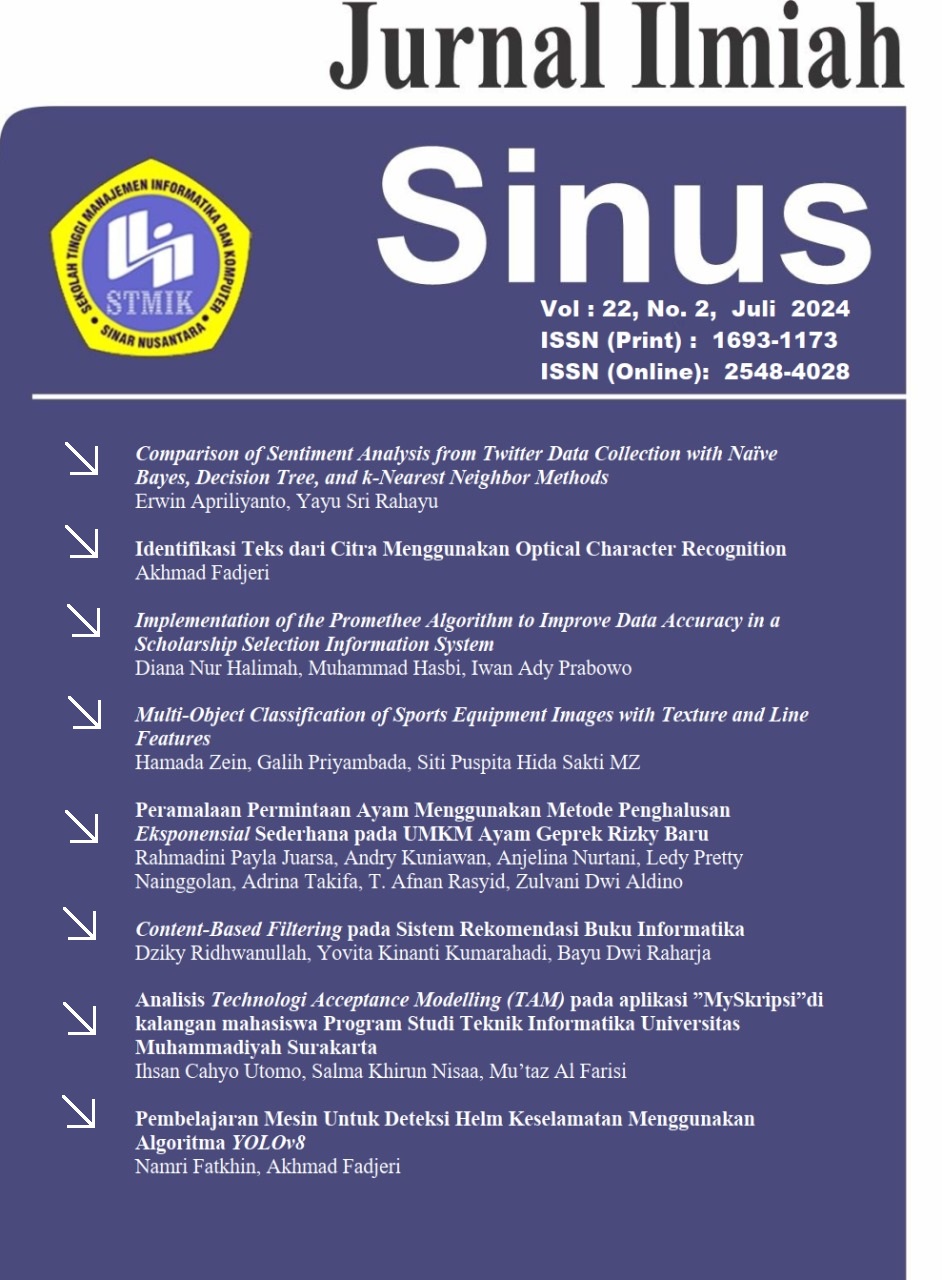
Implementation of the Promethee Algorithm to Improve Data Accuracy in a Scholarship Selection Information System
DOI:
https://doi.org/10.30646/sinus.v22i2.815Keywords:
Scholarship, Promethee Algorithm, Students, Leaving Flow, Entering Flow, Net FlowAbstract
The scholarship selection process at X University has traditionally relied on manual methods, primarily focusing on the highest GPA, which often leads to financial constraints and potential biases. This research aims to address these issues by improving the selection process for scholarship admissions using the Promethee method. By introducing new criteria such as residence status, parental education, employment status, income, home ownership, number of dependents, and life score, the study seeks to provide a more comprehensive and fair assessment. Data collection methods include observation, interviews, and literature study to understand the concept of scholarship selection. The research applied the Promethee algorithm to 20 students who received scholarships from Panasonic in 2023. Confusion matrix analysis showed an accuracy level of 50%, with a precision value of 100% and a recall value of 50%. Despite the need for improved accuracy, it is hoped that the Promethee method can help the X University Student Agency determine fairer and more efficient scholarship selections. This research is expected to contribute positively to improving the scholarship selection process at X University with a focus on efficiency and fairness.
References
A. Syaputra and S. Sasmita, “Implementasi Algoritma Promethee II Pada Pemilihan Media Belajar Daring Di Era Pandemi Covid-19,†J. Sisfokom (Sistem Inf. dan Komputer), vol. 10, no. 3, pp. 340–345, Nov. 2021, doi: 10.32736/sisfokom.v10i3.1290.
C. Name et al., “Analisis Dan Pengembangan Sistem Penerimaan Siswa Baru Tingkat SMA Berbasis Web Dengan Metode Kualitatif†Pap. Knowl. . Towar. a Media Hist. Doc., vol. 3, no. 2, p. 6, 2021.
E. Larasati Amalia, D. Wahyu Wibowo, T. Informatika, and P. Negeri malang, “Antivirus: Jurnal Ilmiah dan Teknik Informatika,†J. Antivirus, vol. 11, no. 1, 2017.
F. Saqdiah, H. Mulyati, and A. Setiawan Slamet, “Analisis Pemilihan Pemasok Kelapa Sawit yang Berkelanjutan dengan Menggunakan Metode Promethee (Studi Kasus pada PT Perkebunan Nusantara III),†J. Manaj. dan Organ., vol. 13, no. 2, pp. 124–133, Jun. 2022, doi: 10.29244/jmo.v13i2.37539.
H. Arofatul Hikmah, “Sistem Pendukung Keputusan Penentuan Penerima Beasiswa Menggunakan Metode Preference Ranking Organization Method For Enrichment Evaluation (Promethee),†vol. 3, 1210.
I. Metode Promethee Untuk Penentuan Mahasiswa Penerima Beasiswa Kurang Mampu Dan Berprestasi Abdal Al Khairi, S. Nazwa Auliani, R. Cahyani Prihandari, S. Aulia Rahmadhani, C. Author, and T. Author, “SENTIMAS: Seminar Nasional Penelitian dan Pengabdian Masyarakat Implementation of the Promethee Method for Determining Underprivileged and Outstanding Scholarship Recipientsâ€, [Online]. Available: https://journal.irpi.or.id/index.php/sentimas
M. Wati and B. Cahyono, “Aplikasi Multi-Criteria Decision Making Penentuan Penerima Bantuan Sosial Santunan Warga Tidak Mampu Menggunakan Promethee,†vol. 2, no. 2, pp. 208–217, 2017.
M. Wati et al., “Sistem Pendukung Keputusan untuk Evaluasi Tingkat Kesejahteraan Masyarakat Menggunakan Metode,†vol. 11, no. x, pp. 184–194, 2021.
T. Tingkat and S. M. U. Dan, “Penggunaan Algoritma Promethee Untuk Pemilihan Guru Teladan Tingkat Smu Dan Smk Bayu Firmanto 6,†vol. 12, no. 1, pp. 48–54.
Downloads
Published
How to Cite
Issue
Section
Citation Check
License
Authors who publish with this journal agree to the following terms:
- Authors retain copyright and grant the journal right of first publication with the work simultaneously licensed under a Creative Commons Attribution License that allows others to share the work with an acknowledgement of the work's authorship and initial publication in this journal.
- Authors are able to enter into separate, additional contractual arrangements for the non-exclusive distribution of the journal's published version of the work (e.g., post it to an institutional repository or publish it in a book), with an acknowledgement of its initial publication in this journal.
- Authors are permitted and encouraged to post their work online (e.g., in institutional repositories or on their website) prior to and during the submission process, as it can lead to productive exchanges, as well as earlier and greater citation of published work (See The Effect of Open Access).
Â

This work is licensed under a Creative Commons Attribution-NonCommercial-ShareAlike 4.0 International License.