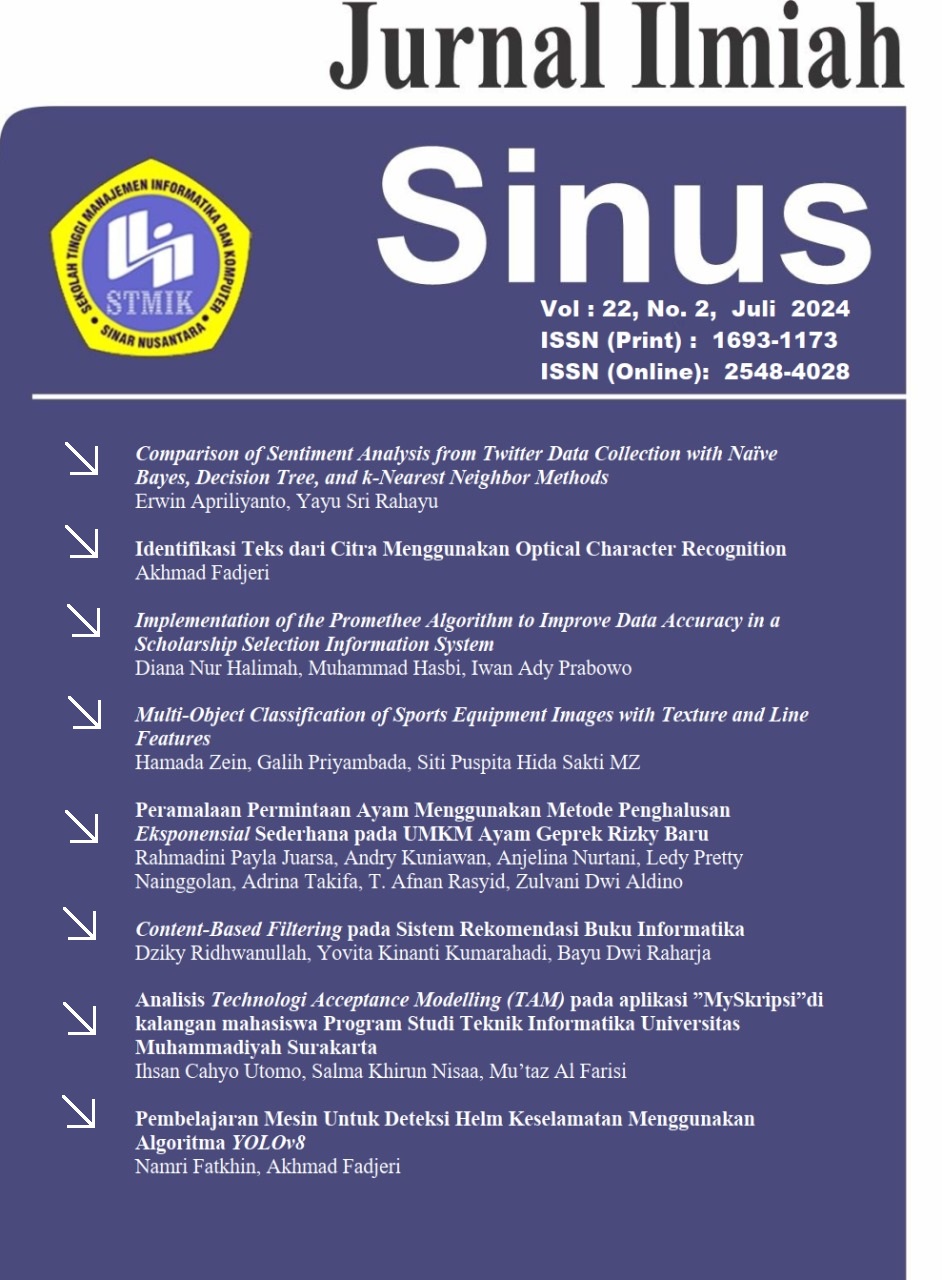
Pembelajaran Mesin Untuk Deteksi Helm Keselamatan Menggunakan Algoritma YOLOv8
DOI:
https://doi.org/10.30646/sinus.v22i2.843Keywords:
You Only Look Once, Deteksi Objek, Alat Pelindung Diri, Helm KeselamatanAbstract
References
Amanda Putri, S., Ramadhan, G., Alwildan, Z., Irwan, I., & Afriansyah, R. (2023). Perbandingan Kinerja Algoritma YOLO Dan RCNN Pada Deteksi Plat Nomor Kendaraan. Jurnal Inovasi Teknologi Terapan, 1(1), 145–154. https://doi.org/10.33504/jitt.v1i1.30
Bao, J., Li, S., Wang, G., Xiong, J., & Li, S. (2023). Improved YOLOV8 Network and Application in Safety Helmet Detection. Journal of Physics: Conference Series, 2632(1). https://doi.org/10.1088/1742-6596/2632/1/012012
Dhruv, A. J., Patel, R., & Doshi, N. (2021). Python: The Most Advanced Programming Language for Computer Science Applications. Proceedings of the International Conference on Culture Heritage, Education, Sustainable Tourism, and Innovation Technologies (CESIT 2020), Cesit 2020, 292–299. https://doi.org/10.5220/0010307902920299
Hadi Supriyanto, Sarosa Castrena Abadi, & Aliffa Shalsabilah. (2024). Deteksi Helm Keselamatan Menggunakan Jetson Nano dan YOLOv7. Journal of Applied Computer Science and Technology, 5(1), 1–8. https://doi.org/10.52158/jacost.v5i1.637
Ji, Y., Cao, Y., Cheng, X., & Zhang, Q. (2022). Research on the Application of Helmet Detection Based on YOLOv4. Journal of Computer and Communications, 10(08), 129–139. https://doi.org/10.4236/jcc.2022.108009
Kumar, T., Mileo, A., Brennan, R., & Bendechache, M. (2023). Image Data Augmentation Approaches: A Comprehensive Survey and Future directions. 6223. https://doi.org/https://doi.org/10.48550/arXiv.2301.02830
Kurnia, J. S., & Risyda, F. (2014). Rancang Bangun Penerapan Model Prototype dalam Perancangan Sistem Informasi Pencatatan Persediaan Barang Berbasis Web. JURNAL SISTEM INFORMASI UNIVERSITAS SURYADARMA, 8(2), 223–230. https://doi.org/10.35968/jsi.v8i2.737
Laily, M. E., Fajri, F. N., & Pratamasunu, G. Q. O. (2022). Deteksi Penggunaan Alat Pelindung Diri (APD) Untuk Keselamatan dan Kesehatan Kerja Menggunakan Metode Mask Region Convolutional Neural Network (Mask R-CNN). Jurnal Komputer Terapan, 8(2), 279–288. https://doi.org/10.35143/jkt.v8i2.5732
Pane, S. F., & Rahcmadani, E. V. (2020). Big Data: Forecasting Menggunakan Python. Kreatif. https://books.google.co.id/books?id=DCjZDwAAQBAJ
Purnomo, D. (2017). Model Prototyping. JIMP-Jurnal Informatika Merdeka Pasuruan, 2(2), 54–61.
Putri, D. N., & Lestari, F. (2023). Analisis penyebab kecelakaan kerja pada pekerja di proyek konstruksi : Literatur review. Jurnal Kesehatan Masyarakat, 7(1), 451–452.
Raup, A., Ridwan, W., Khoeriyah, Y., Supiana, S., & Zaqiah, Q. Y. (2022). Deep Learning dan Penerapannya dalam Pembelajaran. JIIP - Jurnal Ilmiah Ilmu Pendidikan, 5(9), 3258–3267. https://doi.org/10.54371/jiip.v5i9.805
Torang Siregar. (2023). Stages of Research and Development Model Research and Development (R&D). DIROSAT: Journal of Education, Social Sciences & Humanities, 1(4), 142–158. https://doi.org/10.58355/dirosat.v1i4.48
Tsimenidis, S., Vrochidou, E., & Papakostas, G. A. (2022). Omics Data and Data Representations for Deep Learning-Based Predictive Modeling. International Journal of Molecular Sciences, 23(20). https://doi.org/10.3390/ijms232012272
Vishwakarma, A. (2024). a Review: Machine Learning Algorithms. Data Science: Practical Approach with Python & R, 9(1), 162–175. https://doi.org/10.58532/nbennurch299
Zhang, B., Sun, C. F., Fang, S. Q., Zhao, Y. H., & Su, S. (2022). Workshop Safety Helmet Wearing Detection Model Based on SCM-YOLO. Sensors, 22(17). https://doi.org/10.3390/s22176702
Downloads
Published
How to Cite
Issue
Section
Citation Check
License
Authors who publish with this journal agree to the following terms:
- Authors retain copyright and grant the journal right of first publication with the work simultaneously licensed under a Creative Commons Attribution License that allows others to share the work with an acknowledgement of the work's authorship and initial publication in this journal.
- Authors are able to enter into separate, additional contractual arrangements for the non-exclusive distribution of the journal's published version of the work (e.g., post it to an institutional repository or publish it in a book), with an acknowledgement of its initial publication in this journal.
- Authors are permitted and encouraged to post their work online (e.g., in institutional repositories or on their website) prior to and during the submission process, as it can lead to productive exchanges, as well as earlier and greater citation of published work (See The Effect of Open Access).
Â

This work is licensed under a Creative Commons Attribution-NonCommercial-ShareAlike 4.0 International License.