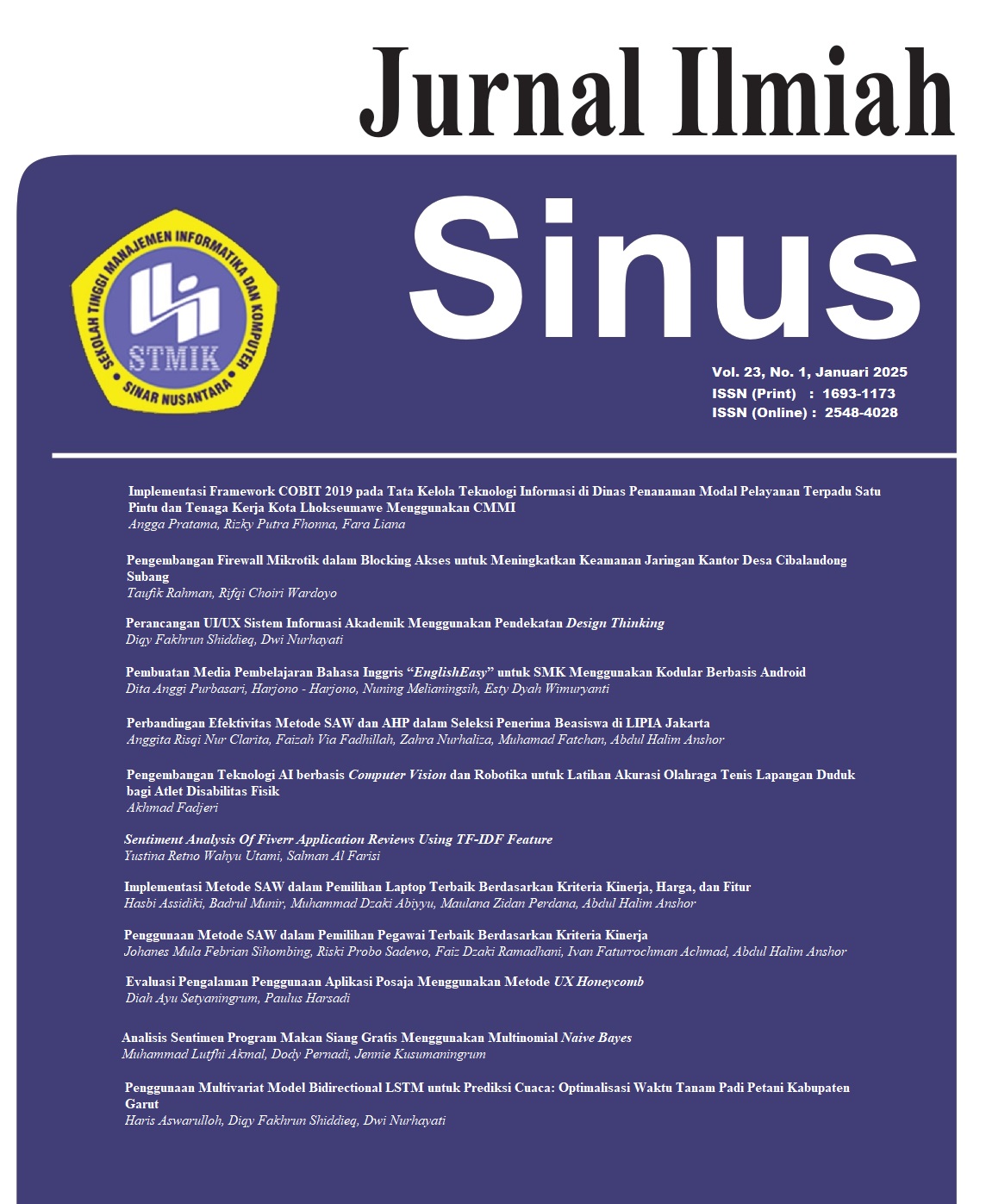
Analisis Sentimen Program Makan Siang Gratis Menggunakan Multinomial Naive Bayes
DOI:
https://doi.org/10.30646/sinus.v23i1.899Keywords:
Analisis Sentimen, Lexicon Based, Multinomial Naive Bayes, Makan Siang Gratis, Twitter(X)Abstract
References
Astari, N. M. A. J., Dewa Gede Hendra Divayana, & Gede Indrawan. (2020). Analisis Sentimen Dokumen Twitter Mengenai Dampak Virus Corona Menggunakan Metode Naive Bayes Classifier. Jurnal Sistem Dan Informatika (JSI), 15(1), 27–29. https://doi.org/10.30864/jsi.v15i1.332
Fibriyanti Arminda, N., Sulistiyowati, N., & Nur Padilah, T. (2023). Implementasi Algoritma Multinomial Naive Bayes Pada Analisis Sentimen Terhadap Ulasan Pengguna Aplikasi Brimo. JATI (Jurnal Mahasiswa Teknik Informatika), 7(3), 1817–1822. https://doi.org/10.36040/jati.v7i3.7012
Hadaina, F., & Budiyanto, U. (2022). Implementasi Metode Multinomial Naïve Bayes Untuk Sentiment Analysis Terhadap Data Ulasan Produk Colearn Pada Google Play Store. Seminar Nasional Mahasiswa Fakultas Teknologi Informasi (SENAFTI) Jakarta-Indonesia, September, 660–666. https://senafti.budiluhur.ac.id/index.php
Hasri, C. F., & Alita, D. (2022). Penerapan Metode NaãÂVe Bayes Classifier Dan Support Vector Machine Pada Analisis Sentimen Terhadap Dampak Virus Corona Di Twitter. Jurnal Informatika Dan Rekayasa Perangkat Lunak, 3(2), 145–160. https://doi.org/10.33365/jatika.v3i2.2026
Hidayatullah, M., Alam, S., & Jaelani, I. (2021). Sentiment Analysis of Police Performance On Twitter Users Using Naïve Bayes Method. RISTEC : Research in Information Systems and Technology, 2(2), 86–97. https://doi.org/10.31980/ristec.v2i2.1945
Kahi, F. R. B., Talakua, A., & Reynaldi, R. (2024). Analisis Sentimen Masyarakat Di Twitter Terhadap Pemerintahan Anies Baswedan Menggunakan Metode Naive Bayes Classifier. Jurnal Minfo Polgan, 13(1), 324–336. https://doi.org/10.33395/jmp.v13i1.13636
Koto, F., & Rahmaningtyas, G. Y. (2017). Inset lexicon: Evaluation of a word list for Indonesian sentiment analysis in microblogs. Proceedings of the 2017 International Conference on Asian Language Processing, IALP 2017, 2018-Janua(December), 391–394. https://doi.org/10.1109/IALP.2017.8300625
Mahendra, M. H., Murdiansyah, D. T., & Lhaksmana, K. M. (2023). Analisis Sentimen Tweet COVID-19 menggunakan K-Nearest Neighbors dengan TF-IDF dan Ekstraksi Fitur CountVectorizer. DIKE : Jurnal Ilmu Multidisiplin, 1(2), 37–43. https://doi.org/10.69688/dike.v1i2.35
Mujahidin, S., Hasyim, M. N., & Pratama, B. M. (2022). Implementasi Analisis Sentimen Opini Publik Mengenai Sirkuit Internasional Mandalika Pada Twitter Menggunakan Metode Multinomial Naïve Bayes Classifier. Bianglala Informatika, 10(2), 129–136. https://doi.org/10.31294/bi.v10i2.13544
Rilinka, R., Indriati, I., & Yudistira, N. (2021). Analisis Sentimen Penghapusan Ujian Nasional pada Twitter menggunakan Document Frequency Difference dan Multinomial Na ï ve Bayes. Jurnal Pengembangan Teknologi Informasi Dan Ilmu …, 5(3), 876–883. http://j-ptiik.ub.ac.id/index.php/j-ptiik/article/download/8659/3981
Sitanggang, A., Umaidah, Y., Umaidah, Y., Adam, R. I., & Adam, R. I. (2024). Analisis Sentimen Masyarakat Terhadap Program Makan Siang Gratis Pada Media Sosial X Menggunakan Algoritma Naïve Bayes. Jurnal Informatika Dan Teknik Elektro Terapan, 12(3). https://doi.org/10.23960/jitet.v12i3.4902
Syarifuddinn, M. (2020). Analisis Sentimen Opini Publik Mengenai Covid-19 Pada Twitter Menggunakan Metode Naïve Bayes Dan Knn. INTI Nusa Mandiri, 15(1), 23–28. https://doi.org/10.33480/inti.v15i1.1347
Wardani, N. S., Prahutama, A., & Kartikasari, P. (2020). Analisis Sentimen Pemindahan Ibu Kota Negara dengan Klasifikasi Naïve Bayes untuk Model Bernoulli dan Multinomial. 9, 237–246.
Wati, R., Ernawati, S., & Rachmi, H. (2023). Pembobotan TF-IDF Menggunakan Naïve Bayes pada Sentimen Masyarakat Mengenai Isu Kenaikan BIPIH. Jurnal Manajemen Informatika (JAMIKA), 13(1), 84–93. https://doi.org/10.34010/jamika.v13i1.9424
Yuyun, Hidayah, N., & Sahibu, S. (2018). Algoritma Multinomial Naïve Bayes Untuk Klasifikasi Sentimen Pemerintah Terhadap Penanganan Covid-19 Menggunakan Data Twitter. Resti, 1(1), 19–25.
Downloads
Published
How to Cite
Issue
Section
Citation Check
License
Authors who publish with this journal agree to the following terms:
- Authors retain copyright and grant the journal right of first publication with the work simultaneously licensed under a Creative Commons Attribution License that allows others to share the work with an acknowledgement of the work's authorship and initial publication in this journal.
- Authors are able to enter into separate, additional contractual arrangements for the non-exclusive distribution of the journal's published version of the work (e.g., post it to an institutional repository or publish it in a book), with an acknowledgement of its initial publication in this journal.
- Authors are permitted and encouraged to post their work online (e.g., in institutional repositories or on their website) prior to and during the submission process, as it can lead to productive exchanges, as well as earlier and greater citation of published work (See The Effect of Open Access).
Â

This work is licensed under a Creative Commons Attribution-NonCommercial-ShareAlike 4.0 International License.