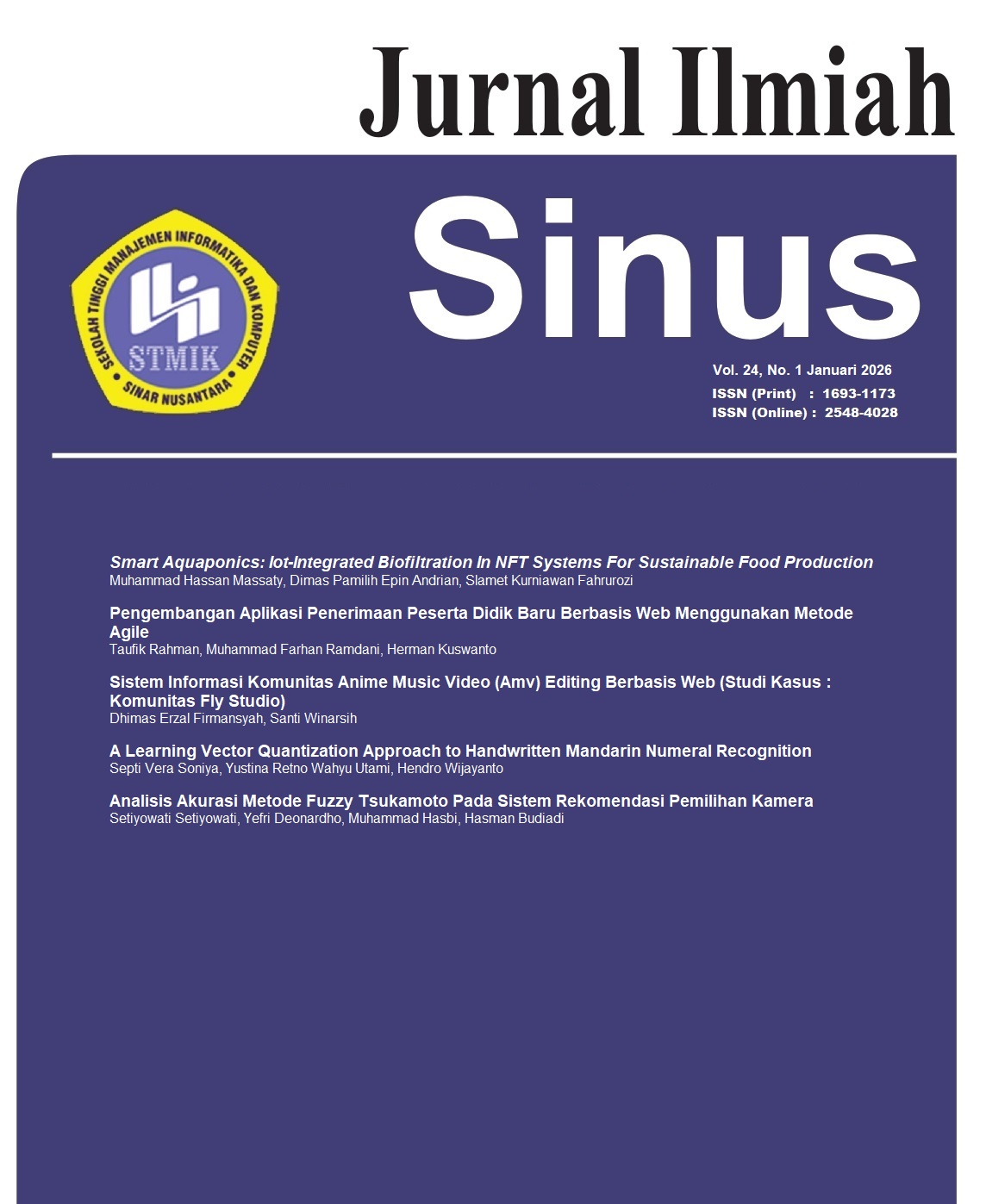
Smart Aquaponics: Iot-Integrated Biofiltration In NFT Systems For Sustainable Food Production
DOI:
https://doi.org/10.30646/sinus.v24i1.1008Keywords:
aquaponics, biofiltration, internet of things, nft, food securityAbstract
References
Abdulmouti, H., Minhas, W., Skaf, Z., Abousamra, R., & Alex, A. (2023). The applicability of the solar-powered aquaponics mobile unit at Sharjah Campus for sustainable perspectives of food security. Design, Construction and Maintenance, 3, 237-252. doi:https://doi.org/10.37394/232022.2023.3.23
Adjovu, G. E., Stephen, H., James, D., & Ahmad, S. (2023). Measurement of Total Dissolved Solids and Total Suspended Solids in Water Systems: A Review of the Issues, Conventional, and Remote Sensing Techniques. Remote Sensing, 15(14), 3534.
Albou, E. M., Abdellaoui, M., Abdaoui, A., & Boughrous, A. A. (2024). Agricultural practices and their impact on aquatic ecosystems–a mini-review. Ecological Engineering & Environmental Technology, 25. doi:https://doi.org/10.12912/27197050/175652
Ardyan, E., Boari, Y., Akhmad, A., Yuliyani, L., Hildawati, H., Suarni, A., . . . Judijanto, L. (2023). Metode Penelitian Kualitatif dan Kuantitatif: Pendekatan Metode Kualitatif dan Kuantitatif di Berbagai Bidang: PT. Sonpedia Publishing Indonesia.
Ashouri, G., Hoseinifar, S. H., El-Haroun, E., Imperatore, R., & Paolucci, M. (2023). Tilapia fish for future sustainable aquaculture Novel approaches toward sustainable tilapia aquaculture (pp. 1-47): Springer.
Barroga, E., Matanguihan, G. J., Furuta, A., Arima, M., Tsuchiya, S., Kawahara, C., . . . Izumi, M. (2023). Conducting and writing quantitative and qualitative research. Journal of Korean medical science, 38(37). doi:https://doi.org/10.3346/jkms.2023.38.e291
Brent, R. N., Kunkel, J., Tomek, Z., Buchardt, D., DeLisle, P. F., & Sivers, S. (2022). A Novel Approach to Developing Thresholds for Total Dissolved Solids Using Standardized and Experimental Toxicity Test Methods. Environmental Toxicology and Chemistry, 41(11), 2782-2796. doi:10.1002/etc.5466
Chen, X., Shuai, C., & Wu, Y. (2023). Global food stability and its socioâ€economic determinants towards sustainable development goal 2 (Zero Hunger). Sustainable Development, 31(3), 1768-1780. doi:https://doi.org/10.1002/sd.2482
Dantes, N. (2023). Desain eksperimen dan analisis data: PT. RajaGrafindo Persada-Rajawali Pers.
de Oliveira Demarco, J., L., H. S., M., B. L., Ganga, H., Mohammad, A., & and Nottingham, E. (2023). Industrial wastewater treatment by plant-based bio-filtration. International Journal of Phytoremediation, 25(14), 1945-1955. doi:https://doi.org/10.1080/15226514.2023.2209191
Debroy, P., Majumder, P., & Seban, L. (2025). A simulation based water quality parameter control of aquaponic system employing model predictive control strategy incorporation with optimization technique. Environmental Progress & Sustainable Energy, 44(1), e14530. doi:https://doi.org/10.1002/ep.14530
Hadi, N. F., & Afandi, N. K. (2021). Literature review is a part of research. Sulawesi Tenggara Educational Journal, 1(3), 64-71. doi:https://doi.org/10.54297/seduj.v1i3.203
Iftikhar, T., Zubair, S., waseem Iqbal, M., Hamid, K., & Nazir, A. (2023). Cost Effective About IoT-Based Accordingly to Weather Monitoring System Development and Improve Averageof Crops. Jilin Daxue Xuebao GongxuebanJournal Jilin Univ. Eng. Technol. Ed, 42, 123-152. doi:https://doi.org/10.17605/OSF.IO/TKAH8
Intania, Z., Fadhillah, A., Fahmi, M. A., & Rif'iyati, D. (2024). Solusi Ketahanan Pangan dan Peningkatan Ekonomi Rumah Tangga Melalui Inovasi Budikdamlon (Budidaya Ikan Lele dan Kangkung dalam Galon). Dharmahita: Journal of Community Service and Development, 81-88. doi:https://doi.org/10.28918/dharmahita.v1i2.8804
Kraus, S., Breier, M., Lim, W. M., Dabić, M., Kumar, S., Kanbach, D., . . . Liguori, E. (2022). Literature reviews as independent studies: guidelines for academic practice. Review of managerial science, 16(8), 2577-2595. doi:https://doi.org/10.1007/s11846-022-00588-8
Kusumanti, I., Firdausi, A. P., Ramadhani, D. E., & Indriastuti, C. E. (2023). Sosialisasi Potensi Bisnis Ikan Nila (Oreochromis niloticus) di Desa Nagrak, Kabupaten Cisaat, Sukabumi. Agrokreatif: Jurnal Ilmiah Pengabdian Kepada Masyarakat, 9(2), 154-163. doi:https://doi.org/10.29244/agrokreatif.9.2.154-163
Mohapatra, B. C., Chandan, N. K., Panda, S. K., Majhi, D., & Pillai, B. R. (2020). Design and development of a portable and streamlined nutrient film technique (NFT) aquaponic system. Aquacultural Engineering, 90, 102100. doi:https://doi.org/10.1016/j.aquaeng.2020.102100
Nagothu, S. K., Bindu Sri, P., Anitha, G., Vincent, S., & Kumar, O. P. (2025). Advancing aquaculture: Fuzzy logic-based water quality monitoring and maintenance system for precision aquaculture. Aquaculture International, 33(1), 32. doi:https://doi.org/10.1007/s10499-024-01701-2
Ninasari, A., Suwarno, K., & Suleyman, S. (2024). Inovasi Teknologi Pertanian: Pengaruh Sistem Hidroponik terhadap Pertumbuhan Sayuran. Jurnal Review Pendidikan Dan Pengajaran (JRPP), 7(4), 17090-17094. doi:https://doi.org/10.31004/jrpp.v7i4.38574
Nuraisyah, T. K., Khalila, K., Putri, S. R. R., Nisa, N. A., & Qulbi, S. H. (2025). Perkembangan Food Estate di Indonesia: Analisis Peluang, Tantangan, dan Ancaman secara Domestik serta Global. Jurnal Syntax Admiration, 6(2), 1099-1115. doi:https://doi.org/10.46799/jsa.v6i2.2110
Omweno, J. O., Argwings, O., Sieberi, B. M., Angima, M., & Ondieki, P. M. (2024). Utilization of aquatic plants and microalgae for sustainable aquaculture production and potential biotechnological applications. Tropical Environment, Biology, and Technology, 2(2), 57-71. doi:10.53623/tebt.v2i2.451
Prajapat, B. (2025). Success Factors in Fish Larval Production: Educohack Press.
Romdona, S., Junista, S. S., & Gunawan, A. (2025). Teknik Pengumpulan Data: Observasi, Wawancara, dan Kuesioner. JISOSEPOL: Jurnal Ilmu Sosial Ekonomi dan Politik, 3(1), 39-47. doi:https://doi.org/10.61787/taceee75
Seroja, S., Dohad, M., Ishak, N., Tan, M., & Abro, G. (2024). IoT-Based Monitoring and Optimization of Nutrient Film Technique Aquaponic Systems: Influence of Bio-Mechanical Filtration on Growth Rates of Oreochromis Niloticus and Brassica Rapa. International Journal of Computational Thinking and Data Science, 4, 10-18. doi:https://doi.org/10.37934/ctds.4.1.1018
Setiawan, B., Styawati, S., & Alim, S. (2024). Implementasi sistem IoT pada akuakultur dan hydroponik (akuaponik) modern untuk pertumbuhan ikan nila. Jurnal Informatika: Jurnal Pengembangan IT, 9(1), 47-53. doi:https://doi.org/10.30591/jpit.v9i1.5896
Shi, C., Ma, J., Wu, H., Luo, J., Liu, Y., Li, K., . . . Wang, K. (2022). Evaluation of pH regulation in carbohydrate-type municipal waste anaerobic co-fermentation: Roles of pH at acidic, neutral and alkaline conditions. Science of the Total Environment, 853, 158327. doi:10.1016/j.scitotenv.2022.158327
Stoyanova, S., Sirakov, I., & Velichkova, K. (2024). Sustainable Production: Integrating Medicinal Plants with Fish Farming in Aquaponics—A Mini Review. Sustainability (2071-1050), 16(15). doi:https://doi.org/10.3390/su16156337
Syaputra, A., & Prawira, N. S. (2024). Implementasi Teknologi IoT dalam Sistem Akuaponik dan Akuakultur Modern untuk Optimasi Pertumbuhan Ikan Lele. ILKOMNIKA, 6(3), 383-392. doi:https://doi.org/10.28926/ilkomnika.v6i3.692
Yahya, M. Z., Linayati, L., & Furoidah, A. F. (2022). Penambahan tepung kencur (Kaempferia galanga L.) terhadap efisiensi pemanfaatan pakan dan rasio konversi pakan ikan bandeng (Chanos chanos). Pena Akuatika: Jurnal Ilmiah Perikanan dan Kelautan, 21(1), 1-14. doi:https://doi.org/10.31941/penaakuatika.v21i1.1765
Yodita, Z. P., Suryaningsih, L., & Santoso, B. B. (2024). Pengaruh Media Tanam Campuran dan Dosis Pupuk Npk 16: 16: 16 terhadap Pertumbuhan Bibit Kelor (Moringa oleifera Lam.). Jurnal Ilmiah Mahasiswa Agrokomplek, 3(3), 236-245. doi:https://doi.org/10.29303/jima.v3i3.5742
Yusoff, F. M., Umi, W. A., Ramli, N. M., & Harun, R. (2024). Water quality management in aquaculture. Cambridge Prisms: Water, 2, e8. doi:https://doi.org/10.1017/wat.2024.6
Zainal, A., Yulianto, H., & Yanfika, H. (2021). Financial benefits of the environmentally friendly aquaponic media system. IOP Conference Series: Earth and Environmental Science, 739(1), 012024. doi:https://doi.org/10.1088/1755-1315/739/1/012024
Zebua, O., Zega, A., Zebua, R. D., Laoli, D., Dawolo, J., & Telaumbanua, B. V. (2024). Krisis biodiversitas perairan: Investigasi solusi berbasis komunitas untuk pemulihan ekosistem aquatik. Manfish: Jurnal Ilmiah Perikanan dan Peternakan, 2(2), 69-79. doi:https://doi.org/10.62951/manfish.v2i2.47
Downloads
Published
How to Cite
Issue
Section
Citation Check
License
Authors who publish with this journal agree to the following terms:
- Authors retain copyright and grant the journal right of first publication with the work simultaneously licensed under a Creative Commons Attribution License that allows others to share the work with an acknowledgement of the work's authorship and initial publication in this journal.
- Authors are able to enter into separate, additional contractual arrangements for the non-exclusive distribution of the journal's published version of the work (e.g., post it to an institutional repository or publish it in a book), with an acknowledgement of its initial publication in this journal.
- Authors are permitted and encouraged to post their work online (e.g., in institutional repositories or on their website) prior to and during the submission process, as it can lead to productive exchanges, as well as earlier and greater citation of published work (See The Effect of Open Access).
Â

This work is licensed under a Creative Commons Attribution-NonCommercial-ShareAlike 4.0 International License.