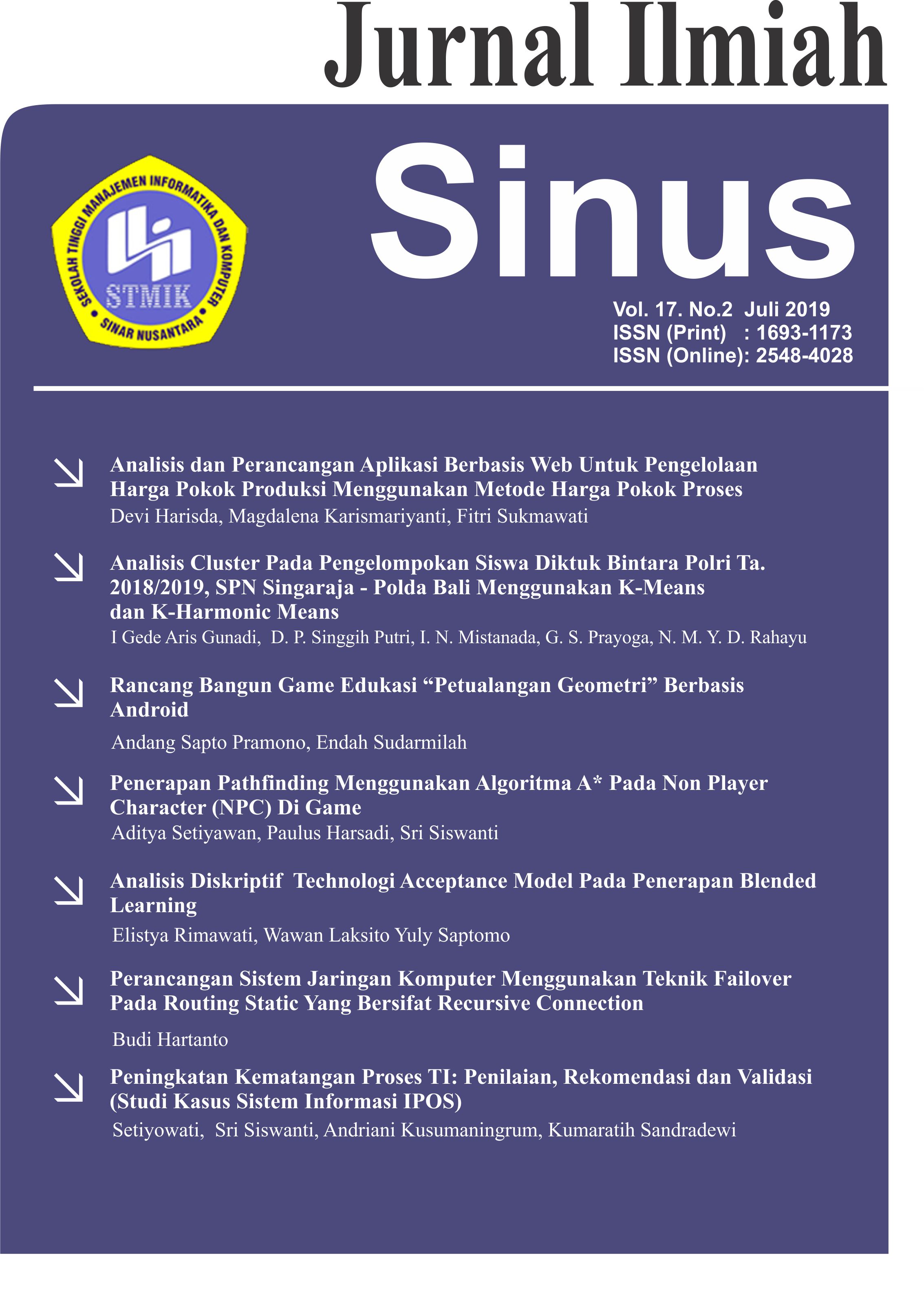
Rancang Bangun Game Edukasi “Petualangan Geometri†Berbasis Android
DOI:
https://doi.org/10.30646/sinus.v17i2.401Keywords:
android, educational games, geometry gamesAbstract
References
Abror, A. F. (2012). Mathematics Adventure Games Berbasis Role Playing Game (Rpg) Sebagai Media Pembelajaran Mata Pelajaran Matematika Kelas VI SD Negeri Jetis, 10.
Adiwijaya, M. (2015). Perancangan Game Edukasi Platform Belajar Matematika Berbasis Android Menggunakan Construct 2, 6.
Arindiono, R. Y., Ramadhani, N., & Hakim, J. A. R. (2013). Perancangan Media Pembelajaran Interaktif Matematika Untuk Siswa Kelas 5 SD, 2, 5.
Balaji, S. (2012). Wateerfallvs V-Model Vs Agile: A Comparative Study On SDLC. . . Vol., (1), 5.
Burnette, E. (2009). Hello, Android: Introducing Google’s Mobile Development Platform (2nd Ed). Raleigh, N.C: Pragmatic Bookshelf.
Firdaus, M., & Nugroho, H. W. (2016). Rancang Bangun Game Edukasi Asah Otak Anak Berbasis Android Menggunakan Aplikasi Construct 2, 10.
Handriyantini, E. (2009). Permainan Edukatif (Educational Games) Berbasis Komputer Untuk Siswa Sekolah Dasar, 7.
Jati Alvionita Kartini. (T.T.). Pembuatan Game Edukasi Sejarah Kemerdekaan Indonesia Untuk Kelas V Sekolah Dasar Negeri Kebonromo 1 Kabupaten Sragen Menggunakan Construct 2, 23.
Korhonen, H. (2016). Evaluating Playability Of Mobile Games With The Expert Review Method, 280.
Korhonen, H., & Koivisto, E. M. I. (2006). Playability Heuristics For Mobile Games. Dalam Proceedings Of The 8th Conference On Human-Computer Interaction With Mobile Devices And Services - Mobilehci ’06 (Hlm. 9). Helsinki, Finland: ACM Press. Https://Doi.Org/10.1145/1152215.1152218
Rahadi, M. R., Satoto, K. I., & Windasari, I. P. (2016). Perancangan Game Math Adventure Sebagai Media Pembelajaran Matematika Berbasis Android. Jurnal Teknologi Dan Sistem Komputer, 4(1), 44. Https://Doi.Org/10.14710/Jtsiskom.4.1.2016.44-49
Rifai, W. A. (2015). Pengembangan Game Edukasi Lingkungan Berbasis Android, 140.
Yadav, R. S. (2012). Improvement In The V-Model. International Journal Of Scientific &Engineering Research, 3(2), 8.
Yunus, M., Astuti, I. F., & Khairina, D. M. (2015). Game Edukasi Matematika Untuk Sekolah Dasar. Informatika Mulawarman : Jurnal Ilmiah Ilmu Komputer, 10(2), 59. Https://Doi.Org/10.30872/Jim.V10i2.192
Downloads
Published
How to Cite
Issue
Section
Citation Check
License
Authors who publish with this journal agree to the following terms:
- Authors retain copyright and grant the journal right of first publication with the work simultaneously licensed under a Creative Commons Attribution License that allows others to share the work with an acknowledgement of the work's authorship and initial publication in this journal.
- Authors are able to enter into separate, additional contractual arrangements for the non-exclusive distribution of the journal's published version of the work (e.g., post it to an institutional repository or publish it in a book), with an acknowledgement of its initial publication in this journal.
- Authors are permitted and encouraged to post their work online (e.g., in institutional repositories or on their website) prior to and during the submission process, as it can lead to productive exchanges, as well as earlier and greater citation of published work (See The Effect of Open Access).
Â

This work is licensed under a Creative Commons Attribution-NonCommercial-ShareAlike 4.0 International License.