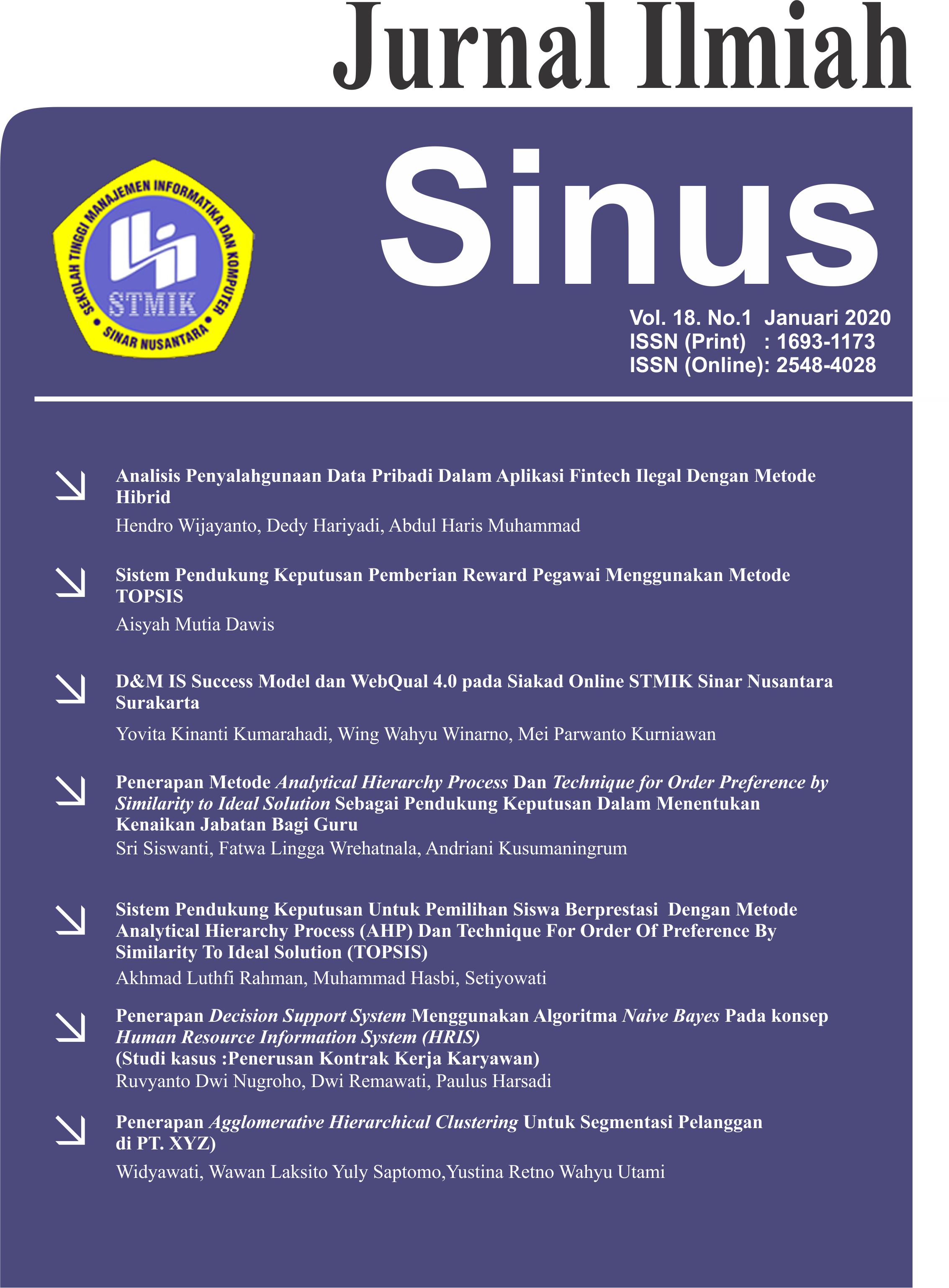
D&M IS Success Model dan WebQual 4.0 pada Siakad Online STMIK Sinar Nusantara Surakarta
DOI:
https://doi.org/10.30646/sinus.v18i1.455Keywords:
D&M IS Success Model, siakad, net benefits, quality factorAbstract
Decision making must be accompanied by a strong foundation in which knows the net benefits felt by the system user. This study aims to determine the effect of variables on the D&M IS Success Model and WebQual 4.0 in Siakad Online STMIK Sinar Nusantara Surakarta. This research used quantitative method with a questionnaire as a data collection tool. The results show that the research indicators and combination models get significant results. The indicator of research has a significant effect on the combination model. D&M Model IS Success Model and WebQual 4.0 have significance value of 90% and R2 of 84%. It means information quality, system quality, service quality, and website qualityhave significance effects to Siakad Online intention to use and SiakadOnline’s user satisfaction. Then, intention to use and user satisfaction have significance effects to SiakadOnline’s user net benefits. Thus, this combination model is able to describe the relationship between indicators well. Suggestion that can be considered for future research is the addition of other external variables, such as gender.
References
Absharina, E. D., Wijaya, F. K., & Jaya, I. D. (2018). Analisis Kesuksesan Sistem Informasi E-KKN LP2M UIN Raden Fatah Palembang dengan Menggunakan Model Delone dan Mclean. Jurnal Intelektualita: Keislaman, Sosial, Dan Sains, 7(2), 217–228.
Al Fatta, H. (2007). Analisis dan Perancangan Sistem Informasi untuk keunggulan bersaing perusahaan dan organisasi modern. Andi.
Alzahrani, A. I., Mahmud, I., Ramayah, T., & Alfarraj, O. (2017). Modelling Digital Library Success Using the Delone and Mclean Information System Success Model. Journal of Librarianship and Information Science, 1–16. https://doi.org/10.1177/0961000617726123
Aswati, S., Mulyani, N., Siagian, Y., & Syah, A. Z. (2015). Peranan Sistem Informasi Dalam Perguruan Tinggi. Jurnal Teknologi Dan Sistem Informasi, 1(2), 79–86. Retrieved from http://is.its.ac.id/pubs/oajis/index.php/file/download_file/1466
Dalimunthe, N., & Pertiwi, L. (2018). Analisa Kesuksesan Penerapan SIKAD UIR Dengan Model Delone dan McLean. In Konferensi Nasional Sistem Informasi (pp. 350–356). Pangkalpinang: STMIK Atma Luhur.
FKM-UNSRAT. (n.d.). Konsep Dasar dan Penerapan Sistem Informasi Kesehatan. Manado.
Ngafifi, M. (2014). Kemajuan Teknologi Dan Pola Hidup Manusia Dalam Perspektif Sosial Budaya. Jurnal Pembangunan Pendidikan: Fondasi Dan Aplikasi, 2(1), 33–47. https://doi.org/10.21831/jppfa.v2i1.2616
Rahayu, F. S., Aprilianto, R., & Putro, Y. S. P. W. (2018). Analisis Kesuksesan Sistem Informasi Kemahasiswaan (SIKMA) dengan Pendekatan Model DeLone dan McLean. Indonesian Journal of Information Systems (IJIS), 1(1), 34–46.
Sekaran, U., & Bougie, R. (2013). Research Methods For Business : A Skill-Building Approach. Wiley.
Tarwoto, & Kuncoro, A. P. (2019). Evaluasi Penerapan Sistem Informasi Smart Prodi dengan Pendekatan Delone Mclean dan Framework COBIT 5 (Studi Kasus: Sistem Penjadwalan Perkuliahan STMIK Amikom Purwokerto). Jurnal MATRIK, 18(2), 222–246.
Yanti, S., & Nugroho, H. (2018). Analisis Faktor-Faktor Penerimaan dan Niat Keberlanjutan Penggunaan Portal Akademik Siakad STMIK Akakom Menggunakan TAM Serta Model Delone dan Mclean. Jurnal Informatika Dan Komputer (JIKO), 3(1), 37–45.
Downloads
Additional Files
Published
How to Cite
Issue
Section
Citation Check
License
Authors who publish with this journal agree to the following terms:
- Authors retain copyright and grant the journal right of first publication with the work simultaneously licensed under a Creative Commons Attribution License that allows others to share the work with an acknowledgement of the work's authorship and initial publication in this journal.
- Authors are able to enter into separate, additional contractual arrangements for the non-exclusive distribution of the journal's published version of the work (e.g., post it to an institutional repository or publish it in a book), with an acknowledgement of its initial publication in this journal.
- Authors are permitted and encouraged to post their work online (e.g., in institutional repositories or on their website) prior to and during the submission process, as it can lead to productive exchanges, as well as earlier and greater citation of published work (See The Effect of Open Access).
Â

This work is licensed under a Creative Commons Attribution-NonCommercial-ShareAlike 4.0 International License.